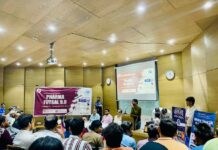
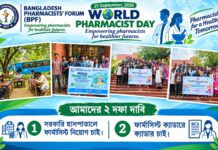
The Bangladesh Pharmacists Forum has called on the government to take immediate steps to integrate pharmacists fully into the national healthcare system, emphasizing the urgent need for hospital and clinical pharmacists, adherence to international standards, and improved professional recognition. The call came during a high-level discussion meeting chaired by the newly appointed Minister of Health and Family Welfare, Sardar Md. Sakhawat Hossain, at the Bangladesh Secretariat. The meeting, held in the conference room of the Ministry of Health and Family Welfare (Room No. 332, Building No. 3, Bangladesh Secretariat), was attended by senior leaders of the Bangladesh Pharmacists Forum, President Md. Azibur Rahman, General Secretary Mohammad Mehedi Hasan Tanvir, Senior Vice President SM Anwar Majid Tarek, Publicity Secretary Md. Mominul Islam, among others.
During the session, the forum presented a comprehensive six-point demand plan aimed at modernizing pharmacy services, enhancing public health safety, and including and aligning Bangladesh’s healthcare system with international norms and World Health Or Organization (WHO) guidelines. The demands focused on the formal appointment of hospital and clinical pharmacists, the inclusion of pharmacists in the BCS health cadre, and the establishment of an independent pharmacy directorate, among other key reforms.
Introduction of Hospital and Clinical Pharmacy Services: The forum stressed that all government hospitals should establish hospital pharmacy departments and clinical pharmacy services, appointing qualified graduate pharmacists in accordance with international models. This, they argued, would ensure rational and safe use of medications, reduce medical errors, and enhance patient-centered care Inclusion in BCS Health Cadre: Pharmacists should be
formally included in the Bangladesh Civil Service (BCS) health cadre, a move that would recognize their essential role in public health and healthcare delivery. Formation of an Independent Pharmacy Directorate: Establishing an independent directorate would improve the efficiency, oversight, and quality of hospital pharmacy and clinical pharmacy activities across the country.
Launch of Pharm D Programs and Phased Conversion from B Pharm: The forum urged the government to introduce Doctor of Pharmacy (Pharm D) programs in line with global standards and gradually convert existing Bachelor of Pharmacy (B Pharm) programs in both government and private universities to Pharm D curricula.
Standardized Tenninology in Recruitment: The forum recommended that recruitment circulars clearly differentiate between graduate pharmacists and diploma holders. Only graduates should carry the title “Pharmacist,” while diploma holders should be explicitly designated as “Diploma Pharmacist,” consistent with both Bangladeshi law and international practice.
Qualified Leadership in Drug Administration: The forum demanded that only graduate pharmacists be appointed as Drug Superintendents in the Directorate General of Drug Administration (DGDA) and called for stricter measures to prevent illegal pharmacy practice by unregistered individuals.
Speaking to the media after the meeting, President Md. Azibur Rahman highlighted the alarming gap in pharmacist representation in the national besithcare system. “According to international standards and WHO guidelines, at least one pharmacist is required for every 10,000 people, and one pharmacist for every 20 hospital beds is considered optimal,” he said. “However, most government hospitals in Bangladesh do not even have posts for graduate pharmacists, which poses a serious risk to public health.”
He further noted that there are currently about 25,000 registered graduate pharmacists in the country and around 35,000 trained 000 trained professionals, including diploma holders. “These skilled professionals contribute significantly to the pharmaceutical industry, research, education, and healthcare both in Bangladesh and abroad. Yet their proper inclusion in the national health system remains unaddressed,” Rahman added.