



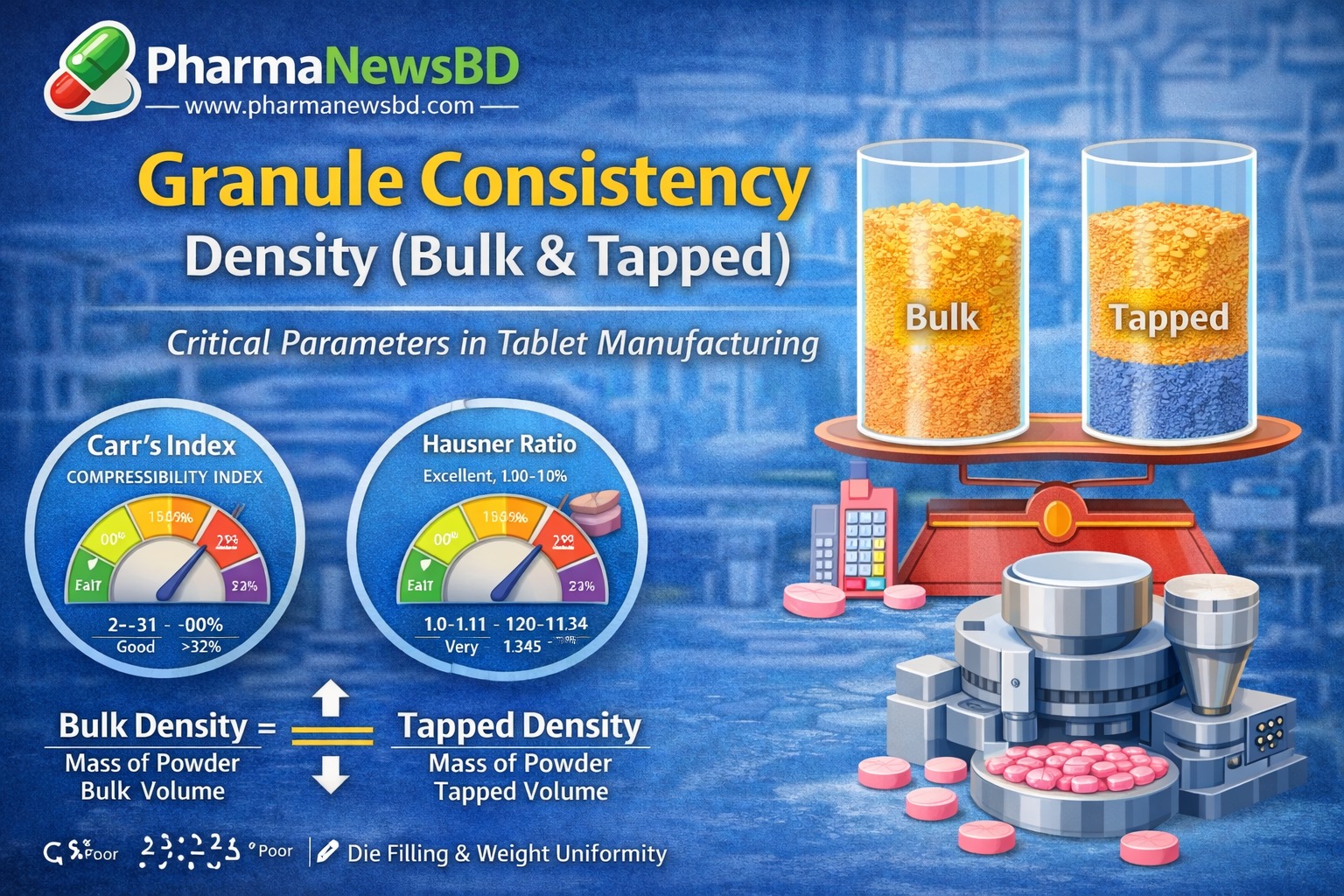
PharmaNewsBD Feature
Tablet Granules Consistency & Density (Bulk and Tapped): Critical Quality Factors in Pharmaceutical Manufacturing
Dhaka, Bangladesh – February 2026 — In pharmaceutical tablet manufacturing, product quality begins long before compression. Industry experts emphasize that granule consistency and density control (bulk and tapped density) are among the most critical parameters influencing tablet uniformity, process stability, and regulatory compliance.
As Bangladesh continues to strengthen its position in global pharmaceutical markets, maintaining consistent granulation standards has become a strategic priority for manufacturers.
Why Granule Consistency Matters
Granule consistency refers to the uniformity of physical and mechanical properties of granules within a batch and between batches. Variations in these properties can directly impact tablet performance.
Key parameters include:
-
Particle size distribution
-
Moisture content
-
Bulk density
-
Tapped density
-
Flow characteristics
-
Binder distribution
Inconsistent granules often lead to compression defects such as capping, lamination, weight variation, and hardness fluctuation
Understanding Bulk and Tapped Density
Bulk Density
Bulk density measures the mass of granules divided by the total untapped volume, including void spaces between particles. It reflects natural packing behavior and die-filling performance.
Tapped Density
Tapped density measures the density after mechanical tapping, representing the powder’s ability to settle and pack under vibration or compression forces.
The relationship between these two parameters provides critical insights into compressibility and flow behavior.
Industry Indicators of Flow and Compressibility
Two derived parameters are commonly used:
-
Carr’s Index (Compressibility Index)
-
Hausner Ratio
Lower values indicate better flow properties and more stable compression performance. Excessive variation in these values often signals upstream granulation instability.
Impact on Tablet Manufacturing
Variations in density can result in:
-
Weight variation
-
Compression force fluctuation
-
Hardness inconsistency
-
Dissolution variability
-
Increased rejection rates
Experts note that many compression problems blamed on rotary tablet presses are actually rooted in density instability during granulation.
Stable density ensures:
-
Uniform die filling
-
Consistent compression force
-
Predictable tablet hardness
-
Reduced defect rate
GMP and Regulatory Significance
According to WHO GMP, US FDA cGMP, EU GMP, and DGDA guidelines, physical testing of granules—including bulk and tapped density—is essential before compression.
Regulatory compliance requires:
-
Defined acceptance criteria
-
Calibrated equipment
-
Documented in-process controls
-
Batch-to-batch trend analysis
-
Proper deviation management
Density testing plays a vital role in process validation, scale-up, and technology transfer.
Preventive Industry Strategies
Pharmaceutical manufacturers are adopting the following measures to ensure granule consistency:
-
Controlled granulation endpoint
-
Optimized drying parameters
-
Standardized milling procedures
-
Environmental humidity control
-
Real-time in-process monitoring
-
Routine density trending
These measures significantly reduce production variability and improve regulatory confidence.
Industry Outlook
With increasing regulatory scrutiny and international market expansion, granule consistency is becoming a key competitive factor in pharmaceutical manufacturing.
Experts agree: controlling density at the granulation stage is not merely a quality check—it is a strategic process control step that safeguards the entire tablet manufacturing cycle.
Granule Consistency in Tablet Manufacturing
Granule consistency is one of the most critical factors in producing high-quality tablets. Inconsistent granules directly lead to weight variation, hardness fluctuation, capping, lamination, and dissolution failure. In fact, many compression problems actually originate from poor granulation control.
What is Granule Consistency?
Granule consistency refers to uniformity in:
-
Particle size distribution
-
Moisture content
-
Density (bulk & tapped)
-
Flow properties
-
Binder distribution
-
Drug content uniformity
Consistent granules ensure smooth die filling and stable compression.
Key Parameters of Granule Consistency
1. Particle Size Distribution (PSD)
-
Too many fines → Capping, lamination
-
Too many coarse particles → Weight variation
-
Ideal: Balanced distribution for good packing
Controlled through:
-
Proper milling screen size
-
Controlled sieve analysis
2. Moisture Content
-
High moisture → Sticking & picking
-
Low moisture → Weak tablets, poor binding
Typical LOD range:
-
1.5% – 3.5% (varies by formulation)
Measured using:
-
Loss on Drying (LOD)
-
Moisture analyzer
3. Flow Property
Poor flow leads to:
-
Weight variation
-
Content uniformity issues
Measured by:
-
Angle of repose
-
Hausner ratio
-
Carr’s Index
Good flow:
-
Hausner ratio < 1.25
-
Carr’s Index < 20%
4. Bulk & Tapped Density
Affects:
-
Die filling
-
Tablet weight uniformity
Inconsistent density causes:
-
Variable compression force
-
Hardness variation
5. Binder Distribution
Uneven binder leads to:
-
Soft tablets
-
Lamination
-
Poor friability results
Proper mixing time and granulation endpoint control are critical.
Causes of Poor Granule Consistency
-
Over-wetting during wet granulation
-
Under-drying
-
Over-drying
-
Improper milling
-
Inadequate blending time
-
Segregation during transfer
-
Poor raw material quality
Impact on Tablet Quality
If granules are inconsistent, you may observe:
-
Capping
-
Lamination
-
Weight variation
-
Hardness fluctuation
-
Friability failure
-
Dissolution variability
-
High rejection rate
GMP Control Measures
To maintain granule consistency:
✔ Validate granulation process
✔ Monitor moisture during drying
✔ Perform sieve analysis routinely
✔ Control milling speed and screen size
✔ Use IPC before compression
✔ Maintain documented SOPs
✔ Record environmental conditions (RH & Temperature)
Industry Insight
Many manufacturing failures blamed on rotary compression machines are actually granulation issues. A stable granulation process reduces downstream defects and improves overall batch yield.
If you want, I can now prepare:
-
A PharmaNewsBD news-style article
-
A technical training manual section
-
A GMP audit checklist for granulation
-
A troubleshooting chart (problem vs cause vs solution)
-
A visual infographic content outline
Density (Bulk & Tapped) in Tablet Manufacturing
Bulk and tapped density are critical physical parameters of granules or powder blends. They directly influence die filling, tablet weight variation, compression behavior, and final tablet quality.
Understanding and controlling density helps prevent major compression problems.
Bulk Density
Definition
Bulk density is the mass of powder divided by the total volume it occupies, including the spaces between particles (void spaces).
Formula
Bulk Density=Mass of PowderBulk VolumeBulk\ Density = \frac{Mass\ of\ Powder}{Bulk\ Volume}Bulk Density=Bulk VolumeMass of Powder
How It Is Measured
-
Weigh a known quantity of powder (e.g., 50 g or 100 g)
-
Pour gently into a graduated cylinder
-
Record the initial (untapped) volume
-
Calculate density
Importance in Tablet Manufacturing
-
Determines die filling efficiency
-
Affects tablet weight uniformity
-
Influences hopper and feeder performance
Problems if Too Low
-
Excessive air entrapment
-
Capping & lamination
-
Weight variation
Problems if Too High
-
Poor compressibility
-
Hard tablets with dissolution issues
Tapped Density
Definition
Tapped density is the density obtained after mechanically tapping a measuring cylinder containing the powder until little further volume change occurs.
Formula
Tapped Density=Mass of PowderTapped VolumeTapped\ Density = \frac{Mass\ of\ Powder}{Tapped\ Volume}Tapped Density=Tapped VolumeMass of Powder
Measurement Method
-
Use a tapped density tester
-
Tap 500–1250 times (as per pharmacopeia)
-
Record final reduced volume
-
Calculate density
Relationship Between Bulk & Tapped Density
The difference between bulk and tapped density indicates powder compressibility and flow behavior.
Two important derived parameters:
Carr’s Index (Compressibility Index)
Carr′s Index=Tapped Density−Bulk DensityTapped Density×100Carr’s\ Index = \frac{Tapped\ Density – Bulk\ Density}{Tapped\ Density} \times 100Carr′s Index=Tapped DensityTapped Density−Bulk Density×100
Interpretation:
| Carr’s Index | Flow Property |
|---|---|
| 5–15% | Excellent |
| 16–20% | Good |
| 21–25% | Fair |
| 26–31% | Poor |
| >32% | Very Poor |
Hausner Ratio
Hausner Ratio=Tapped DensityBulk DensityHausner\ Ratio = \frac{Tapped\ Density}{Bulk\ Density}Hausner Ratio=Bulk DensityTapped Density
Interpretation:
| Hausner Ratio | Flow Property |
|---|---|
| 1.00–1.11 | Excellent |
| 1.12–1.18 | Good |
| 1.19–1.25 | Fair |
| 1.26–1.34 | Poor |
| >1.35 | Very Poor |
GMP Significance
WHO GMP, US FDA, EU GMP require proper control of physical parameters affecting product quality.
Bulk & tapped density testing is part of:
-
Granulation stage IPC
-
Pre-compression approval
-
Process validation
-
Scale-up studies
-
Stability trend monitoring
Documentation should include:
-
Method reference
-
Equipment calibration status
-
Acceptance criteria
-
Analyst signature
Impact on Tablet Quality
If density variation is not controlled, the result may be:
-
Weight variation
-
Hardness inconsistency
-
Capping & lamination
-
Dissolution variability
-
High rejection rate
Practical Industry Insight
In many cases, compression problems blamed on rotary tablet machines are actually caused by poor density control in granulation.
Stable density = Stable compression force = Stable tablet quality.
Detailed Explanation: Granule Consistency & Density (Bulk and Tapped)
In tablet manufacturing, granule consistency is one of the most critical quality attributes. Among all physical parameters, bulk density and tapped density play a major role in determining flow behavior, compressibility, die filling, and final tablet quality.
Let’s go deeper technically.
What is Granule Consistency?
Granule consistency refers to the uniformity and reproducibility of granule properties throughout a batch and from batch to batch.
Key consistency parameters include:
-
Particle size distribution
-
Moisture content
-
Bulk density
-
Tapped density
-
Flowability
-
Drug content uniformity
-
Binder distribution
If these parameters vary, tablet defects are almost guaranteed.
Bulk Density (Loose Density)
Definition
Bulk density is the ratio of powder mass to the total volume it occupies before tapping, including inter-particle void spaces.
Bulk Density=MassUntapped VolumeBulk\ Density = \frac{Mass}{Untapped\ Volume}Bulk Density=Untapped VolumeMass
What It Represents
-
Packing behavior under gravity
-
Die filling efficiency
-
Air content in powder
Practical Example
If 100 g granules occupy 200 mL:
Bulk Density=100200=0.5 g/mLBulk\ Density = \frac{100}{200} = 0.5\ g/mLBulk Density=200100=0.5 g/mL
Factors Affecting Bulk Density
-
Particle size
-
Shape of granules
-
Surface roughness
-
Moisture content
-
Presence of fines
-
Granulation method (wet, dry, direct compression)
Manufacturing Impact
Low bulk density:
-
More air entrapment
-
Capping & lamination
-
Inconsistent die filling
High bulk density:
-
Poor compressibility
-
Hard tablets
-
Slow disintegration
Tapped Density
Definition
Tapped density is measured after mechanically tapping the cylinder until the volume becomes constant.
Tapped Density=MassTapped VolumeTapped\ Density = \frac{Mass}{Tapped\ Volume}Tapped Density=Tapped VolumeMass
It reflects the powder’s ability to settle and pack under mechanical vibration.
Example
100 g powder
Tapped volume = 160 mL
Tapped Density=100160=0.625 g/mLTapped\ Density = \frac{100}{160} = 0.625\ g/mLTapped Density=160100=0.625 g/mL
Compressibility Indicators
Bulk and tapped density together indicate flow and compressibility.
Carr’s Index (Compressibility Index)
CI=Tapped−BulkTapped×100CI = \frac{Tapped – Bulk}{Tapped} \times 100CI=TappedTapped−Bulk×100
Using previous example:
CI=0.625−0.50.625×100=20%CI = \frac{0.625 – 0.5}{0.625} \times 100 = 20\%CI=0.6250.625−0.5×100=20%
20% = Fair to good flow
Hausner Ratio
HR=TappedBulkHR = \frac{Tapped}{Bulk}HR=BulkTapped HR=0.6250.5=1.25HR = \frac{0.625}{0.5} = 1.25HR=0.50.625=1.25
1.25 = Acceptable but not excellent flow
Relationship with Granule Consistency
When density values fluctuate:
-
Tablet weight variation increases
-
Compression force fluctuates
-
Hardness becomes inconsistent
-
Dissolution may vary
-
Rejection rate increases
Stable density = Stable compression performance.
Why Density Changes in Production
Common causes:
-
Over-wetting during granulation
-
Under-drying
-
Over-drying (granule shrinkage)
-
Milling with incorrect screen size
-
Excess fines generation
-
Segregation during transfer
-
Humidity variation in production area
-
Scale-up process changes
GMP & Regulatory Importance
WHO GMP / US FDA / EU GMP require:
-
Defined acceptance criteria
-
Validated test method
-
Calibrated tapped density apparatus
-
IPC record before compression
-
Trending of density during validation batches
Density testing is part of:
-
Process validation
-
Scale-up studies
-
Technology transfer
-
Change control evaluation
Typical Acceptable Ranges (General Industry Practice)
Bulk Density: Depends on formulation (commonly 0.4–0.8 g/mL)
Hausner Ratio: <1.25 preferred
Carr’s Index: <20% preferred
Note: These vary depending on formulation type.
Advanced Industry Insight
In high-speed rotary compression machines:
-
Low density variation ensures consistent die fill at high turret speed.
-
Force feeder design depends heavily on powder density.
-
Real-time compression force monitoring reflects density changes.
Many compression problems are not machine faults — they are density instability issues from granulation.
Best Practices for Maintaining Density Consistency
✔ Control granulation endpoint
✔ Monitor moisture during drying
✔ Standardize milling parameters
✔ Prevent segregation
✔ Maintain environmental RH (≤ 50–60% typical)
✔ Perform sieve analysis
✔ Validate scale-up
Conclusion
Bulk and tapped density are not just simple physical tests — they are predictive indicators of compression behavior, tablet quality, and process robustness.
A consistent density profile leads to:
-
Uniform die filling
-
Stable compression force
-
Consistent hardness
-
Lower rejection rate
-
Improved regulatory compliance
Troubleshooting Matrix (Problem → Density Issue → Corrective Action) for Granule Consistency & Bulk/Tapped Density.
Troubleshooting Matrix
Granule Consistency – Density Related Problems
| Production Problem | Possible Density Issue | Root Cause | Corrective Action |
|---|---|---|---|
| Weight Variation | Fluctuating bulk density | Segregation, poor blending | Re-blend, control transfer method, reduce drop height |
| Capping | Low bulk density (high air content) | Excess fines, under-compression | Improve granulation, adjust compression force |
| Lamination | Low bulk density | Air entrapment | Increase pre-compression, optimize binder |
| Hardness Variation | Density inconsistency batch-to-batch | Variable moisture | Control LOD before compression |
| Sticking | High moisture → density variation | Under-drying | Optimize drying temperature & time |
| Poor Flow | High Carr’s Index (>25%) | Excess fines, irregular shape | Adjust milling screen, add glidant |
| Tablet Thickness Variation | Uneven tapped density | Improper drying | Standardize drying endpoint |
| Dissolution Failure | Over-compressed high density granules | Excess compression force | Optimize compression setting |
| High Rejection Rate | Wide density variation | Poor granulation control | Validate granulation process |
| Force Fluctuation in Rotary Press | Inconsistent bulk density | Segregation during feeding | Install proper force feeder & level sensor |
Quick Reference: Acceptable Density Indicators
| Parameter | Preferred Range |
|---|---|
| Carr’s Index | < 20% |
| Hausner Ratio | < 1.25 |
| Bulk Density | Consistent within ±5% batch trend |
| Moisture (LOD) | Formulation specific (often 1.5–3.5%) |
Early Warning Signs in Compression Room
-
Compression force fluctuates rapidly
-
Hopper level affects tablet weight
-
Machine speed change affects hardness
-
Increasing rejection as batch progresses
These often indicate density instability — not machine malfunction.
GMP Preventive Controls
✔ Perform density test before compression start
✔ Re-check density after long machine stoppage
✔ Record environmental RH & temperature
✔ Use IPC trend chart for bulk density
✔ Include density check in BMR
If you want next, I can prepare:
1️⃣ SOP for Bulk & Tapped Density Testing (WHO GMP format)
2️⃣ Excel calculation template format
3️⃣ PharmaNewsBD technical article version
4️⃣ Training presentation content
5️⃣ Full GMP audit checklist section
SOP for Bulk & Tapped Density Testing (WHO GMP Format) for tablet manufacturing.
STANDARD OPERATING PROCEDURE (SOP)
Title: Determination of Bulk Density and Tapped Density of Granules
SOP No.: QC/PHY/BDTD/001
Department: Quality Control
Effective Date: ___
Revision No.: 00
Supersedes: New
Approved By: ___
1.0 Objective
To describe the procedure for determination of Bulk Density and Tapped Density of granules/powder used in tablet manufacturing to ensure consistency and compliance with GMP requirements.
2.0 Scope
This procedure is applicable to:
-
Wet granulation batches
-
Dry granulation batches
-
Direct compression blends
-
Validation batches
-
Commercial production batches
3.0 Responsibility
-
QC Analyst: Perform test and record results
-
QC Supervisor: Review results
-
QA: Verify compliance and documentation
4.0 Definitions
Bulk Density: Mass of powder divided by its untapped volume.
Tapped Density: Mass of powder divided by volume after mechanical tapping.
5.0 Equipment & Materials
-
Analytical balance (calibrated)
-
100 mL or 250 mL graduated cylinder
-
Tapped density apparatus (calibrated)
-
Funnel
-
Spatula
-
Weighing paper
6.0 Procedure
6.1 Bulk Density
-
Weigh accurately 50–100 g of sample (W).
-
Gently pour into a clean, dry graduated cylinder using a funnel.
-
Do not tap or shake the cylinder.
-
Record the initial volume (V₀).
-
Calculate:
Bulk Density=WV0Bulk\ Density = \frac{W}{V₀}Bulk Density=V0W
Record result in g/mL.
6.2 Tapped Density
-
Place the same cylinder in tapped density apparatus.
-
Tap 500 times initially.
-
Record volume.
-
Continue tapping up to 1250 taps if volume changes.
-
Record final tapped volume (Vf).
-
Calculate:
Tapped Density=WVfTapped\ Density = \frac{W}{Vf}Tapped Density=VfW
Record result in g/mL.
7.0 Calculation of Flow Properties
7.1 Carr’s Index
CI=Tapped−BulkTapped×100CI = \frac{Tapped – Bulk}{Tapped} \times 100CI=TappedTapped−Bulk×100
7.2 Hausner Ratio
HR=TappedBulkHR = \frac{Tapped}{Bulk}HR=BulkTapped
8.0 Acceptance Criteria
| Parameter | Acceptance Criteria |
|---|---|
| Carr’s Index | ≤ 20% preferred |
| Hausner Ratio | ≤ 1.25 |
| Bulk Density | Within validated range |
| Tapped Density | Within validated range |
(Note: Exact limits depend on product validation data.)
9.0 Precautions
-
Ensure apparatus calibration status
-
Avoid vibration during bulk measurement
-
Use dry, clean cylinder
-
Record environmental conditions
-
Avoid segregation before sampling
10.0 Documentation
Record in:
-
BMR (Batch Manufacturing Record)
-
IPC Logbook
-
Validation report (if applicable)
Attach calculation sheet.
11.0 Abnormal Results Handling
If results exceed acceptance criteria:
-
Inform Production & QA
-
Hold batch from compression
-
Investigate granulation process
-
Perform root cause analysis
-
Document deviation
12.0 References
-
WHO GMP Guidelines
-
USP <616> Bulk Density & Tapped Density
-
EU GMP Part I
-
DGDA Bangladesh Requirements